Comparative Test Safe and Sound Pro II
Validation and comparison of the measurement equipment used
Reliability of the measurements
For EMF Map, the radiation meter Safe and Sound Pro II is used. Each meter is calibrated by an independent laboratory. The meter remains, however, a consumer meter and is therefore not as exact and precise as professional measurement equipment.
To get an idea of the accuracy of the meter, comparative measurements were conducted with multiple units of the Safe and Sound Pro II. These tests showed that the measurement results are in good agreement with each other.
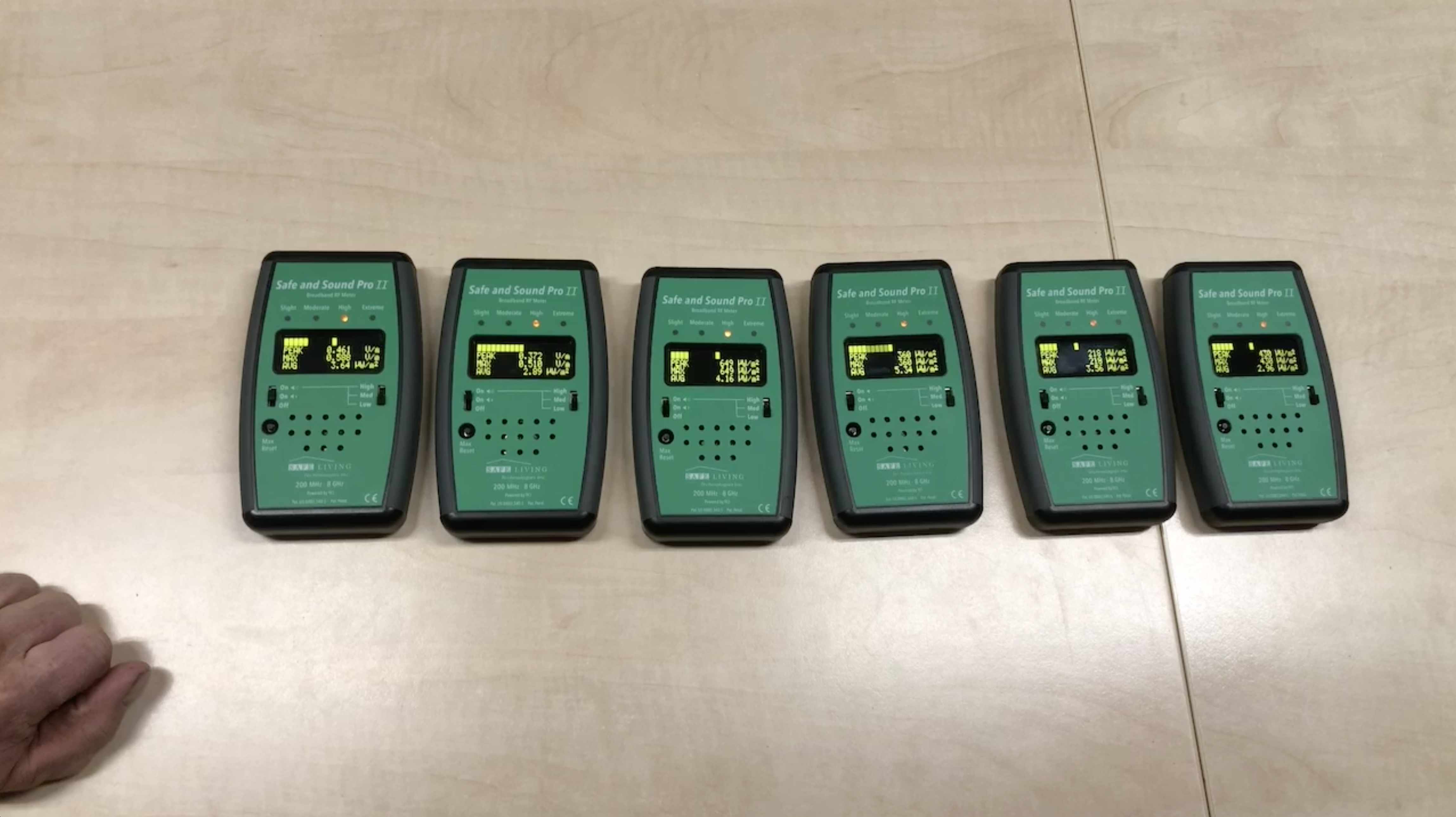
Six decibel deviation?
In the manufacturer's documentation it states that an error margin of 6 decibels is permitted. The meters may have a deviation of 6dB higher or lower.
During measuring, concern arose about those possible deviations. When meters were placed side by side, the values appeared to diverge considerably. This was reason to conduct a test.
Six different meters
Six Safe and Sound Pro II meters from different volunteers were brought together. Some meters were just over a year old, others were new. All were still within the warranty period.
Four different measurements
The meters were tested at four different locations, under varying conditions, from a low-radiation spot to directly under a GSM mast. Would they give the same results?
Fixed methodology
During measurement, the EMF Map measurement protocol was applied. All measurements were performed as all-round measurements (in the four cardinal directions). To keep the approach as consistent as possible, all meters were operated by one and the same person. The measurements were conducted in quick succession to minimise differences in time.
Measurement locations and conditions
The first measurement took place in an agricultural greenhouse. There was no strong radiation source inside, apart from a wifi router at approximately 10 metres distance. The second measurement was outdoors, with a telephone mast on the horizon at approximately one kilometre distance. The third measurement was directly under a telephone mast and the fourth measurement was taken around the corner from that same mast, under a tree.
Limiting external influences
The personal phones and other smart devices of the measurement staff were switched off. In the event of passing people or cars, a measurement was repeated to allow fair comparison. Since the tests were conducted in the evening in a quiet neighbourhood, this was only necessary twice. There was an administrator and the other measurement staff supervised the correct execution.
Varying results
A large difference between the various meters was observable. However, it was not possible to identify a pattern in this. If one meter gave a lower reading in one measurement, that same meter could give a higher reading in another measurement. Radiation always fluctuates everywhere. The waves flow through the air and are never constant.
Unavoidable fluctuations
Because a measurement quickly takes about a minute, this means that the conditions for the subsequent measurement are already no longer the same. Only in a laboratory can conditions be created that allow an exact comparison. At a transmitter mast, radiation is always different.
Standard Deviation AVG
- Measurement 1) 5.65
- Measurement 2) 62.48
- Measurement 3) 2.52
- Measurement 4) 15.97
- Average 0.62
Standard Deviation MAX
- Measurement 1) 0.23
- Measurement 2) 1.39
- Measurement 3) 22.96
- Measurement 4) 1.12
- Average 5.73

All measurement results within the bandwidth
From the results of this test, it can be seen that the meters are well interchangeable. In all measurements, we see that the meters stay neatly within the bandwidths that correspond to the colour scales of EMF Map NL.
One deviation in 48 measured values
Only once is there a deviating colour scale visible for the average radiation (AVG). For the maximum peak values (MAX), all meters are unanimous in their colour scale classification. There is not one meter that stands out.
Conclusion of the comparative test
The Safe and Sound Pro II meters show considerable deviations in individual measurements. However, when we examine the deviations based on the colour scale classification, the effect is limited. Of the 48 test results, only one fell outside the bandwidth of the colour scales. The meters are therefore excellently suited for use with the EMF Map. As indicators, they give a reliable result. Under the same conditions, they give comparable values in terms of colour scale classification.